
Guide to New Mexico Divorce Records
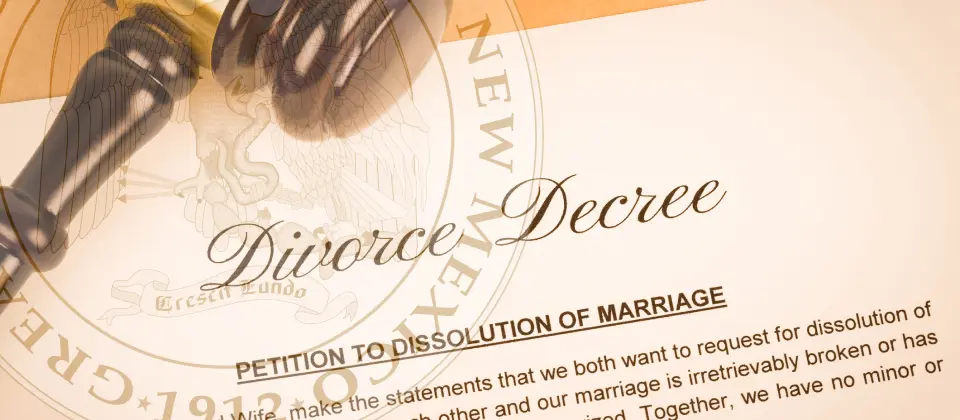
Laws regarding divorce and access to records vary by state. Divorce laws in New Mexico follow a unique set of legal processes, while divorce case records are managed by the courts of New Mexico.
When couples decide to legally terminate their marriage in New Mexico, they must file a divorce case in the appropriate district court in New Mexico. The court will generate several documents as the case proceeds, which will eventually form a part of the official divorce record. The official divorce record documents the legal actions taken and the decisions the court made at the conclusion of the case.
A standard New Mexico divorce record contains many key details about a divorce. These often include:
The full names of both spouses
The case number
The date the divorce was filed
The date the divorce was finalized
The county where the case was heard
The judge who issued the final decree
Summaries of court decisions regarding property division, debt allocation, child custody, visitation schedules, child support, or spousal support
The court that issued a divorce is typically responsible for maintaining official divorce records. An individual seeking copies of these documents must contact the clerk's office of the New Mexico District Court for the county in which the divorce action was filed to obtain them. Additionally, some courts allow access to limited case data via an online search.
Understanding how divorce records are generated, what information they include, and where they are kept will help you obtain a copy of your divorce document(s) when you need them.
Where are New Mexico Divorce Records Stored?

In New Mexico, divorce case files are available at two levels: county courts (District Courts) and state government agencies.
County-Level Courts: Divorce case files are generally retained by the Clerk's Office for the District Court located in the County where your divorce was granted. If you want a copy of the actual divorce decree or the other documents pertaining to your divorce, you can obtain those from the Clerk's Office of that District Court.
Statewide Divorce Index and Certificates: At the state level, access to divorce information and documents is available through the New Mexico Court Case Lookup, an online, secure site created by New Mexico courts and available to registered users.
Records of divorces in New Mexico may be in paper or electronic format, depending on when the divorce case was filed.
Historical Divorce Records: Older divorce records are generally stored as paper files in each county's court archives; these records must be requested in person at the courthouse and retrieved manually.
Current Divorce Records: In contrast to historical divorce records, modern divorce filings are more likely to be digitized, allowing searches of states' online court record systems managed by the state judiciary.
Is New Mexico a 50/50
Yes. New Mexico is a community property state, which means most property and debts you and your spouse acquired during the marriage are considered equally shared. However, even though the court starts with the assumption that each spouse will receive 50% of the assets, it will still look at all the facts and circumstances peculiar to your divorce case.
Community property assumes that all property (assets and debt) acquired during the marriage belongs to both parties equally. When couples get divorced in community property states, the property (and debt) acquired during the marriage will be divided 50/50 unless there is an agreement that provides for a different division.
On the other hand, equitable distribution does not make such an assumption. Under this method, courts will divide the marital property based on their interpretation of what is “fair” for each party involved in the case.
However, before dividing property in a divorce, New Mexico courts consider the following:
Length of the Marriage: When a couple is married for an extended period, it is generally expected that they will have more marital property to divide. However, when couples are married for a short time, the court may need to determine whether certain items are marital or separate property.
Marital vs. Separate Property: Typically, all marital property (i.e., home, income, debts) is split equally between the two parties in a divorce, while the separate property (i.e., gifts, inheritance, etc.) remains the sole property of the original party.
Income and Earning Capacity: Courts consider the incomes of both spouses at the time of divorce, as well as their earning capacity.
Contribution of Each Spouse: The courts consider the spouse's ability to earn income, manage the household, raise children, support the educational endeavors of the other spouse, and provide emotional support to each other when sharing marital property.
Fault Consideration: As a no-fault divorce state, New Mexico does not require a spouse to prove the other spouse caused harm to obtain a divorce. If, however, one spouse utilized or squandered marital funds or assets during the course of the marriage, the court may have to take that into consideration when dividing marital property.
Types of New Mexico Divorce Records

Divorce documents may take various forms depending on the reasons individuals require them. Some are used simply to prove that a divorce occurred, while others are used for legal, financial, or family matters.
New Mexico Divorce Certificate (Certificate of Divorce)
A New Mexico divorce certificate is an official, brief document issued by the New Mexico District Courts confirming that a divorce occurred. The document only gives you a general overview of what happened during the divorce process as opposed to providing all of the specifics related to the court's rulings.
A typical New Mexico divorce certificate will include the names of both parties, the date the divorce was finalized, and the county where it was processed. A divorce certificate may be required for administrative purposes (remarriage, updating social security or government records, identification for legal or financial use).
Divorce Decree (Final Judgment of Divorce)
In New Mexico, a divorce decree, sometimes referred to as the “Final Judgment of Divorce,” is the legally binding court order that represents the District Court's final decision when a divorce case is finalized. The divorce decree is the most authoritative document issued in New Mexico divorce proceedings and contains a detailed record of the judge's decisions.
In New Mexico, the divorce decree is issued by the District Court in the county where the divorce was filed and serves as the legal evidence of the court's decision.
A divorce decree typically includes:
Property and Debt Division: The decree outlines how the couple's assets and liabilities were divided between the spouses.
Child Custody and Support: This part of the decree specifies with whom the children will live (custody) and the type of contact allowed with the non-custodial parent (visitation).
Alimony: The decree states if either spouse is required to make payments for the benefit of their former spouse or for the care of their children.
Final Judgment Date: The official date when the divorce was finalized.
How to File for Divorce in New Mexico (Step-by-Step)
To file for divorce in New Mexico, there is a mandatory six-month residency requirement. According to the New Mexico Statutes Section 40-4-5, either party can file for divorce if at least one party has “resided” in New Mexico for at least six months before filing. The party must also be domiciled in New Mexico. The six-month residency provides the legal basis for New Mexico courts to hear and rule on the divorce case.
It's also important to determine whether your divorce will be uncontested or contested. The type of divorce can affect the duration, cost, and amount of paperwork and stress involved in the process.
Uncontested Divorce: An uncontested divorce occurs when you and your spouse reach an agreement on each major issue of their divorce prior to filing for divorce or shortly thereafter. Those agreements may include how to divide the marital assets and liabilities, who has primary physical custody of the children, and what visitation schedule will be in place. It also includes the amount of child support to be paid and whether either party will receive spousal support.
Uncontested divorces typically require less time, stress, and expense than contested divorces, as there are no major disputes to resolve. Typically, couples can provide a written settlement agreement to the court and obtain finalization of their divorce without appearing for a formal trial.
Contested Divorce: When you are unable to come to an agreement with your spouse on a number of important topics, such as how you will divide property, who has custody of the children, and what type of financial support is required, it is considered a “contested” divorce. Since the parties are unable to reach an agreement, the process becomes more difficult to navigate, and the court becomes involved to help resolve the disagreements.
In a contested divorce, the process can also involve exchanging financial information through “discovery”, attempting to negotiate or mediate with each other, and attending various court hearings to address some temporary matters. If the spouses are unable to reach an agreement, the matter may go to trial. Ultimately, a judge will review the evidence presented and make final decisions that become binding on both parties.
Step-by-Step Divorce Process
In New Mexico, divorce procedures can differ depending on where you live (the county), as well as whether your divorce is contested or if it's an uncontested divorce. Despite this, the initial process for filing a divorce in New Mexico is generally the same.
Prepare the Filing Packet
To start a divorce proceeding in New Mexico, one or both parties to the marriage must prepare and file a proper filing packet with the court. The filing packet is a compilation of all required court documents to initiate the divorce case, along with essential information about the couple's marriage.
Identify the Divorce Path (1A vs. 1B): Before completing the paperwork, it is helpful to determine which type of divorce process applies to your situation, whether it is a contested or uncontested divorce.
Prepare the Required Documents: Most divorce filing packets in New Mexico include several key documents, including:
Petition for Dissolution of Marriage Form: The petition for divorce, or complaint, is the primary document that initiates the divorce proceedings. Use this form if filing for divorce without children, and this form if filing petitioning for dissolution with kids.
Response: The other party to the divorce uses this form to respond to the divorce petition.
Entry of Appearance Pro Se: This form informs the courts whether you will be using legal counsel for the divorce proceedings.
Motion for Temporary Orders: This form is used to ask the court to set temporary rules while the divorce case is ongoing.
Financial Affidavits: This form is used to disclose each party's finances.
Other Forms: Any other form required by New Mexico courts during a divorce case.
You may also be required to submit additional documents, including marriage certificates, proof of New Mexico residency, financial statements, income verification, and child custody documents.
Filing Fees and Fee Waivers (Indecency): Typically, when you file your divorce packet with the court, you will need to pay a filing fee in order to have the case opened. While filing fees may vary by county, they generally range between $200 to $300.
If you are unable to afford the filing fee for opening your case, the New Mexico courts allow you to request a fee waiver. To file a fee waiver, submit a financial information form that demonstrates that you have little or no income or suffer financial hardship. Should the court approve the request for a fee waiver, the filing fee may be reduced or entirely eliminated.
File the Case
The first step after assembling a divorce filing package is to formally file the case with the court.
Where to File
The divorce complaint must be filed at the appropriate county District Court. In most cases, that will be the county where either spouse currently resides or the county where the responding spouse resides. By filing the divorce complaint in the correct county, the court acquires jurisdiction to hear the matter and render enforceable judgments.
Filing Methods
Courts in New Mexico often give divorcing couples several ways to file their divorce case with a District Court, depending on each court's workload and the records available.
In Person: The easiest way for you to file your divorce paperwork is to personally go to the District Court Clerk's Office and file it yourself. The clerk will review your paperwork to confirm that all parts of the documents were completed properly. They will also collect the filing fees.
Mail: If you choose to submit via mail, you will need to mail the completed paperwork, along with the appropriate filing fee usually paid by money order or cashier's check, a self-addressed stamped envelope, and a valid ID to the court Clerk's Office.
Electronic Filing: Depending on the courts in your county, you may also be able to file paperwork electronically using the courts' e-filing system.
What You Receive
The clerk of the court will accept the paperwork and initiate the official divorce process. This will begin the process of issuing various documents and information related to your divorce, including:
The case number assigned to your divorce case, so you can monitor the progress of the case
A summons to be served on the other spouse in a contested case
Any initial notice from the Court or future scheduling information regarding your divorce case
Service of Process (Primarily for Contested Cases)
Once divorce paperwork has been filed with the court and served on the other party, the court will require documentation confirming proper notification. This is known as “proof of service.” The most common techniques for delivering the paperwork to your spouse are:
County Sheriff's Office
Private process server
Certified mail
If the spouse cannot be located and all reasonable efforts to locate the spouse have failed, the court may allow alternative service options to notify the spouse of the filing of the divorce case.
An example of an alternative service option is to publish a public notice of the divorce case filing in a local newspaper. Although the spouse's specific location may be unknown, this type of service allows the spouse the opportunity to respond to the divorce case filing.
Early Case Phase and Temporary Orders
The time between when a divorce case is filed in New Mexico and when it is finalized can be a critical transition period for both parties. During this early phase, a judge can enter a temporary order on important issues. These orders will remain in effect unless changed by another temporary order or when the final judgment is entered. Temporary orders help both parents and any minor children maintain some level of stability during the divorce process.
During the early stages of a divorce, the court will usually attempt to continue with the “status quo”, which includes continuing with all existing routines, responsibilities, etc., so that the divorce process can be conducted with minimal disruptions to your family's daily life.
The most common issues the court issues temporary orders for are:
Temporary child or spousal support: Divorce proceedings often last many months, so a judge can enter an order for temporary financial assistance with necessary expenses until the divorce is finalized.
Temporary custody and visitation: When children are involved, an important issue for the court is establishing where the children will reside and how parenting time will be divided during the divorce process.
Exclusive use of the marital home: In certain circumstances, the court can award one spouse sole temporary use of the marital home. This grants the spouse who remains in the home the right to do so; the other spouse must reside outside the home until the divorce process is completed.
Protective or restraining orders: If a spouse has concerns about their own safety and about harassment or threats by the other spouse, they can seek a protective order from the court.
Financial Disclosures and Discovery
As divorce proceedings continue in New Mexico, most divorcing couples will have to provide the courts and each other with detailed financial information regarding their individual incomes, costs of living, assets, and liabilities. The period during which this occurs is referred to as the financial disclosure and discovery period.
Below are key aspects of financial discovery in New Mexico divorce cases.
Mandatory Financial Disclosure: In most New Mexico divorce cases, each spouse will be asked to prepare financial statements detailing their income, monthly expenses, all assets, and all debt obligations.
Supporting Documents: Spouses are generally required to provide supporting documentation to verify the data included in their financial statements. Examples of such supporting documents include: pay stubs, tax returns, bank statements, credit-card statements, loan documents, and any records associated with their businesses.
Discovery Tools: If, after the above, there remains doubt about a party's financial situation, the spouses have recourse to formal discovery tools to further develop their case. Discovery is a legal process that permits one party to request financial/asset information from the opposing party or from third parties.
Request Documents: A document request asks the other spouse to submit specific financial documents or property records. Document requests could include: business financial records, bank statements, details about investment accounts, and property appraisals.
Interrogatories: An interrogatory is a written list of questions about one spouse's finances sent by one spouse to the other. The responding spouse has to answer those questions in writing and under oath.
Subpoena: A Subpoena is a court order requiring a third party, such as a bank or employer, to produce documents or other important financial information related to the divorce case.
Deposition: The process of questioning a person under oath prior to trial. Depositions are generally conducted by attorneys with a court reporter present to record all testimony.
Case Management and Court Conferences
The Case Management Conference is a preliminary meeting with the judge, who will verify that all documents have been filed, determine which issues remain in dispute, and set future deadlines for actions. The intent behind scheduling these conferences is to continue moving the case toward resolution and to ensure that both parties understand their responsibilities.
The pre-trial conference is conducted at or just prior to the scheduled trial date. The intent of this conference is to determine whether any remaining issues need to be resolved; discuss potential settlement options; identify the last possible deadline for any witnesses/evidence to be submitted prior to trial; and detail the procedures to be followed within the courtroom.
During case management or pre-trial hearings, judges typically expect:
That both spouses have filed their mandated disclosure of income and provided the necessary documentation.
That all discovery requests and responses have been made and/or responded to in a timely fashion.
That the spouses will be prepared to discuss potential settlements as well as identify the specific areas of dispute that require judicial resolution.
That attorneys (and/or self-represented parties) will be able to clearly articulate to the court exactly what they are seeking in terms of judicial determination.
Settlement or Trial
Many divorces in New Mexico are resolved by the couples without going to trial. Once both parties have agreed on all aspects of the divorce, they may then file the settlement with the courts for review and approval. Some of the most commonly used methods to reach a settlement agreement include:
Direct negotiations: Where the divorcing spouses negotiate and agree upon the terms of the divorce themselves.
Mediated negotiations: Where the divorcing spouses meet with a neutral third party, usually a mediator or other trained negotiator, to help facilitate an agreement.
Attorney-negotiated settlements: Where one or both attorneys representing the divorcing spouses negotiate the terms of the divorce directly.
However, if negotiations fail and spouses are unable to reach an agreement on key issues such as the distribution of marital property, child custody, or spousal support, the case will proceed to trial. At that point, the judge will review the evidence presented during the trial and decide how to allocate and address the issues that were not resolved in negotiations. In general, the following events take place during the trial process.
The parties present evidence and call witnesses to testify on why they believe their positions are correct.
The judge issues his/her proposed findings of fact.
The court's final judgment is issued to settle all remaining disputes and divide the marital assets fairly.
Judgment, Waiting Periods, and Finalization
Couples in New Mexico are not required to wait a certain amount of time (known as a “cooling off” waiting period) after they file for divorce to finalize their divorce. Once couples complete the necessary paperwork and resolve the legal issues associated with their divorce, the judge in the New Mexico District Courts may enter the final divorce decree, ending the marriage.
Also, New Mexico does not require a minimum waiting period before remarrying after a divorce is finalized. Generally, divorced individuals may remarry at their earliest convenience after the divorce has become final in New Mexico.
Child Custody and Child Support in New Mexico Divorces
When parents divorce in New Mexico, a court must determine how to provide care to their children after the parents' separation.
Every decision regarding custody of a child made in New Mexico is made with consideration to the “best interest of the child”. Therefore, when a court makes a custody determination, it will evaluate which living arrangement best supports the child's physical and emotional safety and total growth and development, as opposed to which living arrangement the parents want.
In determining what is in the “best interests” of the child, courts will usually consider factors such as
The ability of each parent to communicate and cooperate
The child's own preferences (especially if the child is older)
The child's relationship with each parent and siblings
How well the child has adjusted to his/her home, school, and community
Which parent has primarily looked after the child in the past
Legal Custody vs. Physical Custody
Custody in New Mexico is typically divided into legal custody and physical custody
Legal Custody refers to the right to make major decisions for a child in the child's best interests, such as educational decisions, medical treatment, religious beliefs, etc. The two most common forms of legal custody are Joint Legal Custody (both parents have equal decision-making rights) and Sole Legal Custody (one parent makes all decisions).
Physical custody refers to where the child lives on a daily basis. In most cases, when one parent has primary physical custody, that parent's home is the child's primary residence, and the other parent may have regular visitation (parenting time) under an agreed-upon schedule. There are also situations in which the parents share physical custody, meaning the child spends equal time at each home.
Child Support Guidelines and Enforcement
The primary purpose of child support is to ensure that both parents contribute a fair share toward their children's financial needs. The general rule for determining the amount of child support in New Mexico is set by the New Mexico Child Support Guidelines, which consider factors such as
Each parent's income level
The number of children
How often do the children spend time with each parent
New Mexico has several methods for enforcing child support payments when a parent fails to comply with this responsibility. Some of these are:
Wage garnishment
Withholding tax refunds
Suspending driver's or professional licenses
Liens against property or bank accounts
Court enforcement actions
Property, Debt, and Alimony in New Mexico Divorces
When a New Mexico marriage is ended by divorce, the court will be required to split all of the couple's marital assets and marital debt, as well as determine which spouse has an obligation to make monthly payments to the other for spousal maintenance.
In general, all income earned and all property acquired during the time a couple was married is considered marital property, and thus, it belongs to both parties and will generally be divided on a 50/50 basis. Examples of marital property may include wages or salaries, homes purchased together, and retirement funds or pensions accumulated during the marriage.
Separate property, however, is the property that only belongs to one spouse. This could be property purchased prior to the marriage, personal gifts received by one spouse, or inheritances from deceased relatives. Once separate property has been “commingled”, added with property which was jointly held with the other spouse, it can become difficult to distinguish the property as being separate.
In New Mexico, divorcing couples' debts are split the same way property is. Most of the time, debts incurred by spouses while they are married, for example, credit card debt, home mortgages, and car loans, are treated as joint obligations. Judges strive to divide the couple's debts fairly.
Typically, this is done by pairing the debts with the assets that each party retains after the divorce. For example, if one party keeps the marital home, he/she will be responsible for paying off the mortgage, and if the other spouse receives the car, she/he will be responsible for paying the car loan.
Alimony (spousal support) may be ordered for one spouse to pay to compensate for a financial imbalance following the divorce. In New Mexico, there are several types of alimony that can be ordered by the court based on the specific circumstances:
Periodic alimony, which typically involves regular payments, usually monthly, for a defined amount of time.
Rehabilitative alimony helps one spouse to be economically independent. An example of rehabilitative alimony is providing support to a spouse to complete their education, training, or preparation for employment.
Lump-sum alimony is when an amount of money (one-time) or an amount of money over a short time is paid by one spouse to another.
Errors, Omissions, and Corrections in New Mexico Divorce Records
Sometimes divorce documents may contain incorrect information, such as misspellings, incorrect dates, omissions, or other typographical errors. It is important to correct those errors on your divorce certificate or decree because, if left uncorrected, it may cause you difficulties in the future when attempting to use the document legally or administratively.
To correct an error on a New Mexico divorce certificate, you generally send a written letter to the District Court Clerk's Office where the divorce was granted, along with supporting documentation showing the error.
Court personnel will determine whether this is a minor clerical fix or requires additional court approval to correct the document.
Additionally, if the error is in the divorce decree, you will likely have to formally file a motion to the District Court where the divorce was granted to obtain approval to make corrections and include documentation supporting the correct information.
After your corrections/amendments have been approved, you can obtain updated certified copies of your divorce documents from the District Court clerk's office where the divorce was finalized.
How to Access New Mexico Divorce Records

You can access your New Mexico Divorce records as follows.
Online
You can access divorce information and documents online through the New Mexico Court Case Lookup tool. Users may search for specific case information by entering the names in the cases or docket numbers, and obtain access to view or download all of the New Mexico courts' case files, including divorce records
In Person
To obtain a copy of your divorce decree or certificate, you must contact the District Court Clerk's office in the county where your divorce was finalized. The court staff will assist you with guidance on how to request a certified copy of your divorce decree/certificate, viewing court records, and any applicable fees.
By Mail
If you are unable to visit the court in person, you may be able to request a certified copy of your divorce decree or certificate by mail.
To do this:
Complete the necessary request form for obtaining a certified copy of your divorce certificate or divorce decree.
Include a copy of your valid ID and any additional documentation required, such as a self-addressed stamped envelope.
Mail the request to the District Court in which your divorce was finalized, along with the required fees for the service.
Once the District Court has completed processing, it will mail you the certified copy. Processing time may be several weeks before you receive your document.
New Mexico Courthouses That Handle Divorces
It is essential to know which courts in New Mexico have jurisdiction to hear your divorce case and also which courthouse you need to go to so that you may obtain your divorce records.
Court Authority for New Mexico Divorce Cases
District Courts in New Mexico have the authority to hear and preside over all divorce matters. These courts can award divorces, determine child custody and support, divide property and debts, and enter other related orders. To be considered a valid divorce in the State of New Mexico, a divorce must be filed and heard in a New Mexico District Court and signed by a New Mexico District Court judge.
County-based Filing
A divorce is generally filed in the district court of the county where either spouse lives. When both spouses reside in separate counties, it may be possible to file in the county where one spouse resides. Divorce decrees and certificates are usually available through the District Court. The following list includes places to locate final divorce decrees of some of the most common New Mexico counties.
Bernalillo County District Court - serves Albuquerque and the surrounding areas
Santa Fe County District Court - serves Santa Fe and nearby communities
Doña Ana County District Court - serves Las Cruces and nearby areas
Sandoval County District Court - serves Rio Rancho and the surrounding communities
Jurisdiction Basis
Only the District Courts in New Mexico have jurisdiction regarding divorce and other family law issues. Therefore, only the District Courts can legally grant a divorce, make decisions about custody and visitation, and decide how marital assets and liabilities will be divided. Probate, municipal, or magistrate courts cannot grant divorces or divorce decrees in New Mexico.
Examples of New Mexico District Courts
Each county in New Mexico has a District Court. Here are some county courts in the state:
Bernalillo County - Second Judicial District of New Mexico
Los Alamos County, Rio Arriba County, and Santa Fe County - First Judicial District of New Mexico
Colfax County, Taos County, and Union County - Eighth Judicial District of New Mexico
Sandoval County - Second Judicial District of New Mexico
Role of the District Court Clerk The District Court Clerk's office is an integral part of the divorce process. The Clerk handles:
The filing of divorce petitions and all supporting documentation
Keeping accurate and official court records relating to divorce actions, such as divorce decrees.
Preparing and processing requests for certified copies of divorce certificates and decrees.
Providing general information regarding the procedure and what forms need to be completed.
FAQ
Are divorce records public in New Mexico?
Yes, divorce records are generally public per the New Mexico Inspection of Public Records Act. However, full divorce decree documents may have restricted access to protect sensitive information or personal data from being released. It is also easier to obtain a certificate of divorce than a full decree.
What is the difference between a certificate and a decree?
A divorce certificate is a brief summary of facts that confirm a divorce has occurred. A divorce decree, on the other hand, is the final court document issued at the time of the divorce. It determines custody arrangements, property division, and support obligations between the parties, as well as any other terms of the divorce.
Do I need to know the county?
Yes. Divorce records are filed with and maintained by the district court in the county where the divorce was finalized. Knowing which county to contact will help you to request the records in a timely and efficient manner.
How far back do records go?
The availability of divorce records for New Mexico counties varies widely, but most counties retain records going back several decades. Some older records may require special requests or trips to the courthouse archives to obtain the record.
How much does it cost?
The cost of divorce records varies by record type and the county where the divorce was granted. Typically, certified copies of divorce certificates cost between $10 and $25, while full divorce decree documents can cost more. To find out the exact cost of the record you want to purchase, contact the district court clerk's office in the county where the divorce was granted.
Can I Search New Mexico Divorce Records for Free?
Not really. Divorce records are rarely available for free online. While you can access basic court information for free online, the complete records, especially divorce decrees, are not available online.
Table of Contents
- Where are New Mexico Divorce Records Stored?
- Is New Mexico a 50/50
- Types of New Mexico Divorce Records
- How to File for Divorce in New Mexico (Step-by-Step)
- Step-by-Step Divorce Process
- Child Custody and Child Support in New Mexico Divorces
- Property, Debt, and Alimony in New Mexico Divorces
- Errors, Omissions, and Corrections in New Mexico Divorce Records
- How to Access New Mexico Divorce Records
- New Mexico Courthouses That Handle Divorces
- FAQ